


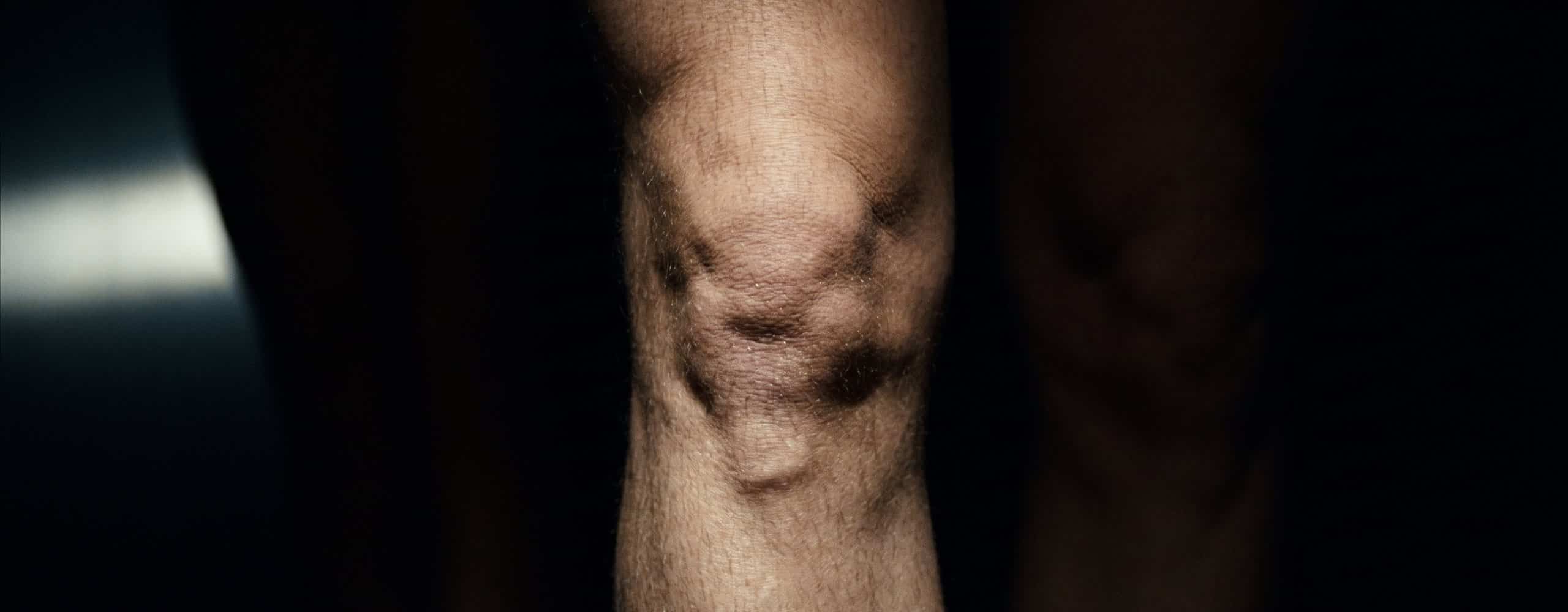
Knee tendonitis is usually patellar tendinopathy, pain on a fingertip-sized spot at the lower edge of the kneecap, brought on by jumping, landing and going downstairs. It improves as you warm up and punishes you hours later. The treatment is a staged loading programme over at least 12 weeks, and resting it is the reliable way to make the problem chronic.
The piece of information that changes most people’s plan: the pain during a session is not the thing to judge by. The following morning is.
Three storeys, three problems
BELOW THE KNEECAP
Patellar tendinopathy, jumper’s knee. Pain on the lower edge of the kneecap, worst jumping, landing and going downstairs. The commonest by far.
ABOVE THE KNEECAP
Quadriceps tendinopathy. Pain on the upper edge, worst on deep squats and getting out of a low chair. Less common, and often missed.
OUTER SIDE OF THE KNEE
Iliotibial band syndrome. Pain on the outside, appearing at a predictable distance into a run and stopping when you stop. Not really a tendon problem at all.
Tendonitis, or something else entirely?
Knee pain is the most over-attributed symptom in this whole family of problems, and getting the label right saves months. Pain a few centimetres below the joint line on the inner side of the shin, for instance, is usually pes anserine bursitis rather than a tendon at all.
| Patellar tendinopathy | Patellofemoral pain | Knee osteoarthritis | |
|---|---|---|---|
| Where | One fingertip spot below the kneecap | Vaguely around and behind the kneecap | Deep in the joint, often the inner side |
| Worst when | Jumping, landing, going downstairs | Sitting a long time, then standing up | First thing in the morning, and after being on it all day |
| Warm-up effect | Improves as you warm up, worse hours later | Grumbles throughout | Eases after 20 minutes, returns with use |
| Swelling | None, or a thickened tendon you can feel | None | Sometimes, inside the joint |
| Age it usually starts | 15 to 40, in jumping and running sports | 15 to 35, often in new runners | Over 45 |
Why the name matters more than usual here
British sources use “tendonitis” and “tendinopathy” almost interchangeably, and that is more honest than it looks, because the second word is the accurate one and the first is what people search for.
The “itis” suffix means inflammation. In a tendon that has hurt for months, inflammation is largely absent. Tissue taken at surgery shows collagen laid down in the wrong directions, a thickened tendon, and new blood vessels and nerve endings growing into a structure that should have neither. A review in the British Medical Journal made that case in 2002, and the reference primer on the subject, published in Nature Reviews Disease Primers in 2021 and led from the University of Glasgow, sets out the current picture. The same reappraisal rewrote the treatment of tennis elbow, where the evidence for loading a painful tendon is strongest.
The practical consequence is direct. Anti-inflammatory tablets are a short-term comfort measure, not a treatment. Nothing rebuilds a tendon except load applied progressively over months. That is the whole of the management plan, and everything else is support for it.
The pain activity ladder
NHS musculoskeletal physiotherapy services in Britain teach this condition through two ideas that are worth learning before your first appointment, because they are the language you will hear used.
The pain activity ladder: how NHS musculoskeletal services stage this
RUNG 1, ISOMETRIC HOLDS
Sit with the knee bent to 60 degrees and push against an immovable resistance, or hold a wall sit. 5 holds of 45 seconds, twice a day. These often reduce tendon pain immediately, and they are the rung to start on however sore the knee is.
RUNG 2, SLOW HEAVY LOADING
Leg press or a slow squat to about 60 degrees, taking 4 seconds down and 4 seconds up. 3 sets of 15, every other day. Heavy enough that the last repetition is genuinely hard.
RUNG 3, ADD RANGE AND SPEED
Deeper squats, split squats, then step-downs. Same slow tempo. Only climb to this rung when rung 2 leaves the knee no worse the next morning for two weeks running.
RUNG 4, ENERGY STORAGE
Hopping, skipping, then jumping and landing. This is the rung that returns you to sport, and the one most people skip, which is why the pain comes back the first time they play.
PACING AND SPACING
Two sessions of the same load, 48 hours apart, beat four sessions crammed into a weekend. Tendons need the gap between sessions to adapt, and that gap is part of the treatment rather than a rest from it.
Judging each session
The rule that governs the whole ladder is simple and it replaces every vaguer piece of advice about listening to your body.
During the exercise, pain of 4 or 5 out of 10 is acceptable and even expected. Soreness in the hours afterwards that has settled by bedtime is fine. Stiffness and soreness that are still there the next morning mean the session was too much, and the correct response is to repeat the previous week’s load rather than to stop altogether.
This one rule handles most of what people ask a physiotherapist. It tells you when to climb a rung, when to hold, and when to step back down. It also settles the question of how many exercises you need, which is fewer than most programmes give you: two or three loaded movements done properly beat a sheet of ten.
What else gets offered, and what it is worth
Isometric holds for pain relief. Genuinely useful, and underused. A 45-second hold at about 60 degrees of knee bend often reduces tendon pain measurably for a couple of hours. That is not a cure, but it is a free way to make a working day tolerable and to get a session started.
A patellar strap. A band worn just below the kneecap changes where the tendon pulls and takes the edge off during activity. Helpful for getting through a match or a shift, with no effect on healing. Treat it the way you would treat a walking stick.
Shockwave therapy. Results are inconsistent, better in long-standing cases than in recent ones, and it is rarely available on the NHS for this. If a private clinic offers it, the honest question is whether the loading programme has been done properly first.
Platelet-rich plasma and other injections. Heavily marketed and weakly supported once compared against a properly delivered exercise programme rather than against nothing. Steroid injection into or around the patellar tendon is generally avoided, because it weakens the tissue in a tendon that has to survive landing from a jump.
Surgery. A genuine option for the small number of people still limited after a year of consistent loading, and almost never appropriate before that. Most people who reach a surgeon have never completed 12 consecutive weeks of the programme.
Getting help on the NHS
In most of England you can refer yourself directly to community musculoskeletal services without seeing a GP first, and every adult in England can now see a first contact physiotherapist at their own practice. For a condition diagnosed by where it hurts and treated by graded exercise, that is the right door and the faster one.
What you will get is advice on load management, a set of exercises, and a review. They will also test the strength of the quadriceps and the hip muscles on both sides, because a weak hip changes how the knee absorbs a landing. If pressing the bony point on the outside of that hip is sore as well, that is a separate tendon problem with its own programme. What you will not usually get, and do not need, is a scan. Ultrasound and MRI show patellar tendon changes in a large proportion of athletes with no symptoms whatsoever, so imaging confirms very little and delays the thing that works.
Do see a GP rather than self-managing if the knee is hot, red and swollen, if you have a fever, if it locks or gives way, if you cannot straighten it, if the pain followed a specific injury with a pop, or if it woke you at night from the beginning. Those point somewhere other than a tendon.
One practical piece of advice for the appointment itself: ask them to show you the exercise rather than describe it, or to point you to a video from the service. The tempo, 4 seconds down and 4 seconds up, is the part that most often gets lost between a leaflet and a living room, and it is the part that does the work.
Where inflammation and supplements fit
Chronic tendon problems are not inflammatory in the way an infected joint is, but the tissue is not inert either: the low-grade inflammatory background that comes with age, weight and inactivity does affect how tendons and joints tolerate load, and that is a legitimate target.
What it is not is a substitute for the ladder. Nothing you swallow rebuilds collagen or teaches a tendon to absorb a landing. If you want to support that background while the loading does the structural work, our tendon support formulation is designed for it, and the absorption problem it is built around is explained on the bioavailable natural anti-inflammatory page.
Frequently asked questions
How do I get rid of tendonitis in my knee?
By loading the tendon in stages rather than resting it. Start with isometric holds, which often reduce the pain within a session, then move to slow heavy squats or leg press, then add range and speed, and finally reintroduce jumping and landing. Give it 12 weeks minimum. Rest settles the pain while it lasts and leaves the tendon exactly as weak, which is why it returns the week you go back to sport.
What does tendonitis of the knee feel like?
A precise sore point you can cover with one fingertip, usually on the lower edge of the kneecap. It is stiff for the first movements of the day, improves as you warm up, feels almost normal during activity, and then aches for hours afterwards or the following morning. That warm-up pattern is the most useful piece of information you have, and it is what separates a tendon problem from a joint problem.
Is it okay to walk with knee tendonitis?
Yes, and walking on the flat is usually one of the least provocative things you can do. What loads a patellar tendon is not walking but jumping, landing, decelerating and going downstairs. Keep walking, take the stairs one at a time going down, and use the next-morning rule to judge how much. Complete rest weakens the tendon and makes the return harder.
What are the four symptoms of tendonitis?
Localised pain over the tendon, tenderness when you press it, stiffness that is worst first thing and after sitting, and pain that is brought on by a specific loaded movement. Visible swelling is not usually one of them: a tendon may feel thickened, but a knee that is puffy and full of fluid is telling you about the joint, not the tendon.
How long does knee tendonitis take to heal?
Three months of consistent loading for a clear improvement and six or more for a full return to jumping sport. That is longer than most people are told and it is important to hear at the start, because the commonest reason for a chronic patellar tendinopathy is a programme abandoned in week three. Improvement is usually noticeable by week six, and it keeps building well beyond that.
Do I need a scan or a referral?
Usually neither at first. Patellar tendinopathy is diagnosed by where it hurts and what brings it on, and ultrasound shows tendon changes in plenty of athletes with no pain at all, so a scan can mislead as easily as it can help. In most of England you can refer yourself straight to community musculoskeletal physiotherapy without going through a GP, which is a faster route than waiting for imaging.
Should I take anti-inflammatories for it?
They help for a few days at the very start, when the pain is stopping you sleeping or preventing you exercising. Beyond the first few weeks they are treating a process that has largely finished, because a tendon that has hurt for months contains very little inflammation and a great deal of disorganised collagen. Please do not use them to push through a session: the pain in that situation is information rather than an obstacle.
What to take away
Today: sit with your knee bent to about 60 degrees and hold a hard push against something immovable for 45 seconds, five times. Most people find the knee feels better immediately afterwards, and that is rung one of the ladder rather than a trick.
Then commit to 12 weeks, climb one rung at a time, and judge every session by the next morning rather than by how it felt at the time. The people who get better from this are almost never the ones who found a clever treatment. They are the ones who were still doing the programme in week ten.
Sources
Malliaras P., Cook J., Purdam C., Rio E. (2015). Patellar tendinopathy: clinical diagnosis, load management, and advice for challenging case presentations. Journal of Orthopaedic and Sports Physical Therapy, 45(11), 887-898. DOI: 10.2519/jospt.2015.5987
Khan K.M., Cook J.L., Kannus P. et al. (2002). Time to abandon the “tendinitis” myth. British Medical Journal, 324(7338), 626-627. DOI: 10.1136/bmj.324.7338.626
Cook J.L., Purdam C.R. (2009). Is tendon pathology a continuum? A pathology model to explain the clinical presentation of load-induced tendinopathy. British Journal of Sports Medicine, 43(6), 409-416. DOI: 10.1136/bjsm.2008.051193
Millar N.L., Silbernagel K.G., Thorborg K. et al. (2021). Tendinopathy. Nature Reviews Disease Primers, 7, 1. DOI: 10.1038/s41572-020-00234-1
Sivrika A.P., Papadamou E., Kypraios G. et al. (2023). Comparability of the effectiveness of different types of exercise in the treatment of Achilles tendinopathy: a systematic review. Healthcare, 11(16), 2268. DOI: 10.3390/healthcare11162268


