


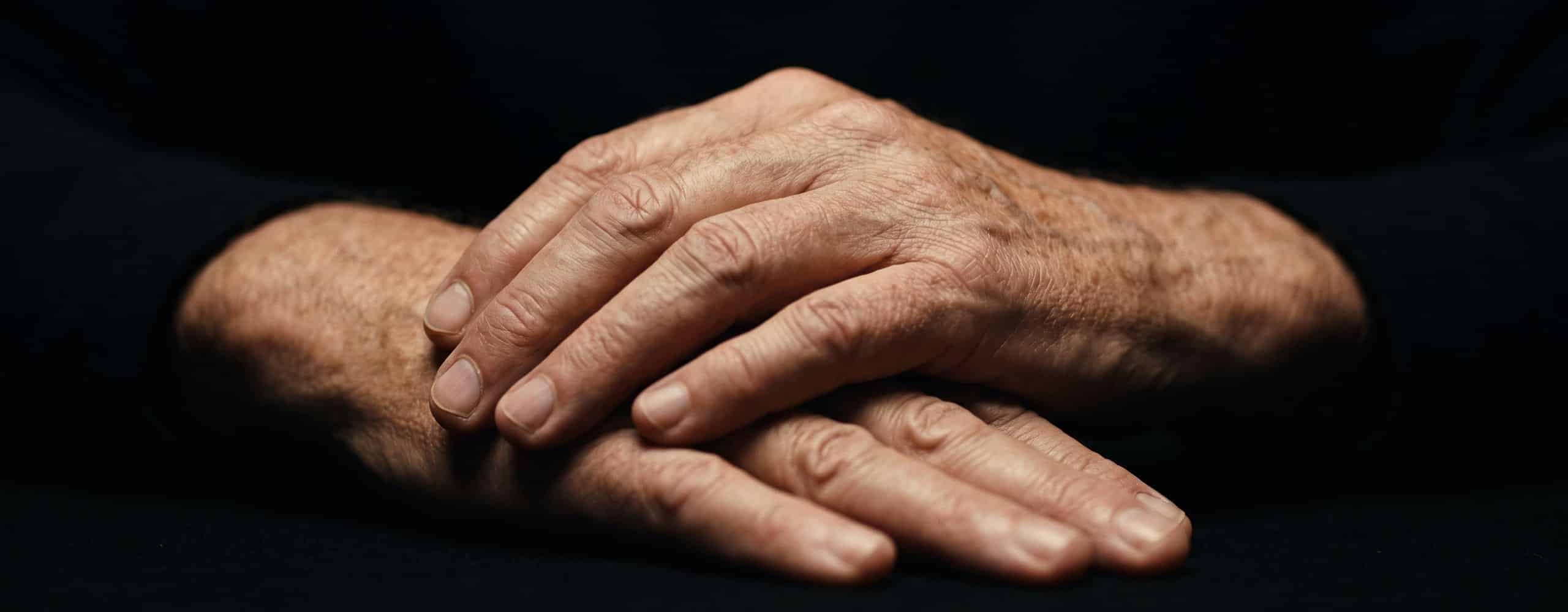
Hand osteoarthritis affects four sites: the thumb base, the end joints of the fingers, the middle joints, and occasionally the wrist. NICE recommends tailored exercise for everyone before any medicine, then a topical anti-inflammatory gel. Glucosamine is specifically not recommended.
Most information on this subject explains what osteoarthritis is and stops. The useful question is different: given that you already have it, what changes the next five years? That is what follows.
Which joints of the hand, wrist and thumb are affected
Where hand and wrist osteoarthritis settles
sites
Thumb base
The joint between thumb and wrist. The single most disabling site, because it carries every pinch: keys, kettles, jar lids, buttons.
End joints of the fingers
Nearest the nails. Produces the hard bony bumps and a fingertip that drifts sideways, but usually less loss of function than the thumb.
Middle joints of the fingers
Less commonly affected than the end joints, and more likely than them to mean something inflammatory is going on.
The wrist itself
Rarely worn out on its own. Wrist osteoarthritis in Britain is usually the late consequence of an old scaphoid fracture or a torn ligament.
Osteoarthritis of the hand, wrist and fingers is common and unevenly spread. The thumb base carries far more load per unit of cartilage than any other joint in the hand, which is why it is the site that most often ends up limiting people, and why the treatments that help it are different from those that help a knobbly fingertip.
The wrist matters here too. Years of strain alone rarely wear a wrist out: British hand clinics see wrist osteoarthritis mainly as a late consequence of injury, and the small joint where the thumb column meets the wrist bones is a frequent source of pain that people describe as coming from the wrist rather than the thumb. Wrist pain that followed a rise in repetitive hand movements, and that you can reproduce on a single tender point over a tendon, is a tendon problem rather than a worn joint.
What the X-ray shows, and why it may not match how you feel
The four grades on an X-ray, and what they mean to you
doubtful narrowing
often no symptoms
clear narrowing
early spurs
multiple spurs
bone reshaping
space gone
marked deformity
Radiographic changes in the hands are extremely common with age, and a large share of people with clear changes on film have no symptoms at all. The reverse is also true: hands that look mild on an X-ray can be painful and stiff every morning.
This is why NICE supports diagnosing osteoarthritis clinically, without imaging, when the presentation is typical. If you leave the surgery without an X-ray, nothing has been skipped. Imaging is for uncertainty, not for confirmation.
How a knuckle turns into a knobble
The treatments, in the order NICE puts them
| Treatment | NICE position | In practice |
|---|---|---|
| Tailored exercise | Offer to everyone | Hand therapy referral, then a home programme you keep going |
| Topical NSAID | First drug of choice | Gel rubbed into the joint, several times a day |
| Oral NSAID | If topical is not enough | Lowest dose, shortest course, stomach protection where needed |
| Paracetamol | Not routinely offered | Occasional short term use only, when nothing else is suitable |
| Glucosamine | Do not offer | Still one of the best selling supplements in Britain |
The ordering is worth reading twice. Tailored therapeutic exercise sits above every drug, for everyone, and it is the recommendation most often skipped. A hand therapist gives you a small set of movements and grip exercises, and the benefit comes from doing them most days rather than doing them perfectly.
Topical anti-inflammatory gel is the first medicine, and the hand is where it makes most sense: the joints sit millimetres under the skin, so a gel reaches them in a way it never reaches a hip. A licensed gel is a different proposition from a traditional poultice, which cools and comforts without reaching the joint at all. Oral anti-inflammatories are the next step, kept short.
Steroid injections into a hand joint give real but short lived relief, and are used when the joint is stopping you doing something specific. They are a way of buying a window in which to build strength, not a treatment on their own.
Splints, grips and the small changes that add up
A thumb base splint worn at night is one of the highest value interventions available for the commonest site of hand osteoarthritis, and it is cheap. Many people find that a few weeks of night splinting settles a thumb that had been aching for months.
Then there is everything you hold. Wide handled peelers and knives, pens with fat barrels, an under shelf jar opener, lever taps instead of round ones, a kettle tipped from a stand. Each one reduces the strain through the thumb, and together they change what a working day feels like.
Cold weather makes hands, wrists and fingers stiffer and more painful, which is not imagination. Warming the hands before a task, and keeping gloves in a coat pocket through the British winter, is a practical piece of self management rather than a comfort measure.
Exercises that keep a hand working
A hand therapist will give you something like the following. It fits into the time a kettle takes, twice a day, and consistency beats intensity: a small programme done most days improves grip strength and function more than an ambitious one abandoned after a fortnight.
- Full fist, slowly. Curl the fingers into a fist, then open them fully with the fingers straight and spread. Ten times, without forcing the end range.
- Thumb to each fingertip. Touch the tip of the thumb to each finger in turn, making a round shape rather than a flat pinch. Two passes on each hand.
- Tabletop bend. Rest the hand flat, then bend only the big knuckles, keeping the fingers straight. This movement stiffens first and matters most for grip.
- Grip squeeze. Squeeze a soft ball or a rolled flannel for five seconds, ten times. Hold rather than pump, and stop short of sharp pain.
- Putty pinch. Pinch therapy putty between thumb and index finger, using a slow squeeze. Hand therapists issue this routinely, and it targets exactly the muscles that protect the thumb base.
People often ask whether they should push into pain. The working answer used by hand therapists is that discomfort during exercise is acceptable and settles within an hour or so, while pain still present the next morning means that session was too much. That is the same next-morning rule that steers a loading programme for a painful tendon.
What about supplements
Be selective, because the market is not. NICE is unambiguous that glucosamine should not be offered for osteoarthritis, and that recommendation has not changed the shelves in any British pharmacy. The evidence sits elsewhere.
Osteoarthritis is now understood as a joint disease with a genuine low grade inflammatory component rather than simple mechanical wear, which is why anti-inflammatory approaches have a rationale here at all. If you are going to try something, judge a bioavailable anti-inflammatory formula on how well the active compound is absorbed rather than on the milligrams claimed, and check what a supplement built for worn joints actually contains before paying for it.
Nothing on that shelf substitutes for the exercise programme. It is an addition to the first row of the table, never a replacement for it.
When to see a GP
- Hand pain that is stopping you doing specific tasks at work or at home, whatever the X-ray might show.
- Morning stiffness lasting more than an hour, which suggests inflammation rather than wear.
- Several joints swelling at once, especially the same ones on both hands.
- A single joint that becomes red, hot and severely painful over a few hours.
- Numbness or tingling in the fingers, which points to a nerve rather than a joint.
Frequently asked questions
What are the early signs of osteoarthritis in the hands?
Stiffness in the fingers for the first ten or twenty minutes after waking, an ache at the base of the thumb when you open a jar or turn a key, and a joint that begins to look slightly wider than the same joint on the other hand. Grip weakens before pain becomes constant. Many people date the start to a task they suddenly could not do.
What are the four stages of osteoarthritis in the hands?
They come from the Kellgren and Lawrence scale used on X-rays. Grade 1 is doubtful narrowing of the joint space, grade 2 clear narrowing with small spurs, grade 3 multiple spurs and reshaping of the bone, grade 4 loss of the joint space with marked deformity. The grade describes the film, not the person: severe X-ray changes are common in hands that work perfectly well.
What is the best treatment for osteoarthritis in the hands?
A combination rather than a single thing. Tailored exercise from a hand therapist, a topical anti-inflammatory gel on the painful joint, a thumb base splint if the thumb is the problem, and changes to how you grip everyday objects. NICE puts exercise first for everyone with osteoarthritis, ahead of any medicine, and that ordering is not arbitrary.
How can hand osteoarthritis be managed day to day?
Spread the load and widen what you hold. Use two hands for a kettle, buy fatter handles for knives and pens, keep an under shelf jar opener, and fit lever taps rather than round ones. Warm your hands before heavy tasks and rest them in short breaks rather than one long stop. These adjustments make more difference over a week than any tablet.
Do hand exercises make osteoarthritis worse?
No. Exercises that keep the joints moving and the muscles strong protect the hand, and stiffness is a bigger long term problem than the wear itself. Some discomfort during and shortly after exercise is expected. Pain that is still worse the following morning means the load was too high for that session, so reduce it rather than stopping.
Does hand osteoarthritis affect the wrist too?
Sometimes, but rarely on its own. The small joint between the thumb and the wrist bones is the common site and is usually counted with the thumb base. True wrist osteoarthritis in the UK is most often the late result of an old scaphoid fracture or a torn ligament that never fully healed, which is why hand surgeons ask about injuries from decades earlier.
Will I need surgery for hand osteoarthritis?
Most people never do. Surgery is discussed when a single joint stays painful and limiting after exercise, splinting, topical treatment and at least one injection have been tried properly. The thumb base is the joint most often operated on in Britain, usually by removing the small trapezium bone. Fingertip joints can be fused, which trades movement for reliable pain relief.
What to take away
Pick the one task your hands make hard. Opening jars, turning the car key, writing a card, fastening a coat. Then change the tool before you change anything else, and start the four minute exercise programme the same week.
Those two moves cost almost nothing and sit at the top of the guideline for a reason. Everything else in this article is what you add when they are already in place.
Sources
Kloppenburg M., Kroon F.P., Blanco F.J. et al. (2019). 2018 update of the EULAR recommendations for the management of hand osteoarthritis. Annals of the Rheumatic Diseases, 78(1), 16-24. DOI: 10.1136/annrheumdis-2018-213826
Robinson W.H., Lepus C.M., Wang Q. et al. (2016). Low-grade inflammation as a key mediator of the pathogenesis of osteoarthritis. Nature Reviews Rheumatology, 12(10), 580-592. DOI: 10.1038/nrrheum.2016.136
Sanchez-Lopez E., Coras R., Torres A. et al. (2022). Synovial inflammation in osteoarthritis progression. Nature Reviews Rheumatology, 18(5), 258-275. DOI: 10.1038/s41584-022-00749-9
Wu R., Peng Q., Wang W. et al. (2024). Systematic review and network meta-analysis on the efficacy and safety of pharmacotherapy for hand osteoarthritis. PLOS ONE, 19(4), e0298774. DOI: 10.1371/journal.pone.0298774
Musorrofiti M.G., Bonifacio M., Cipolloni V. et al. (2026). The use of physical energy-based therapies in the management of osteoarthritis. Medicina, 62(6), 1119. DOI: 10.3390/medicina62061119


