



Black pepper is what makes turmeric worth swallowing. Piperine, the compound behind pepper’s bite, slows the gut and liver enzymes that clear curcumin before it can circulate. In the reference human study, adding 20 mg of piperine raised curcumin absorption by 2,000 percent. That single finding is why nearly every turmeric supplement on a British shelf now lists black pepper extract.
What is actually in turmeric, and what is actually in black pepper
Turmeric is a rhizome. Ground into the yellow powder in your spice rack, it carries a family of pigments called curcuminoids, of which curcumin is the most studied. Those curcuminoids make up only a small share of the root by weight, commonly cited at around 3 percent. The rest is starch, fibre, oils and water.
That proportion matters more than it sounds. A teaspoon of culinary turmeric delivers a few tens of milligrams of curcumin. The trials that report an effect on joint pain use roughly 1,000 mg of curcumin a day, which is why supplements use a concentrated extract rather than the kitchen spice. The gap between what a food contains and what a trial dose delivers is the same gap that makes the antioxidant figure printed on a packet a poor guide to what that food does in a body.
Black pepper works the other way round. Its active compound, piperine, does almost nothing on its own at the doses used in supplements. Its job is to change what happens to another molecule. In a turmeric formula, piperine is not a second active ingredient. It is a delivery decision.
How piperine changes how much curcumin reaches your blood
Curcumin has a well documented problem: the body is very good at getting rid of it. Poor solubility in water, limited uptake across the gut wall, rapid conjugation in the intestinal lining and the liver, then fast excretion. Anand and colleagues catalogued the whole obstacle course in 2007 and called the resulting blood levels vanishingly low.
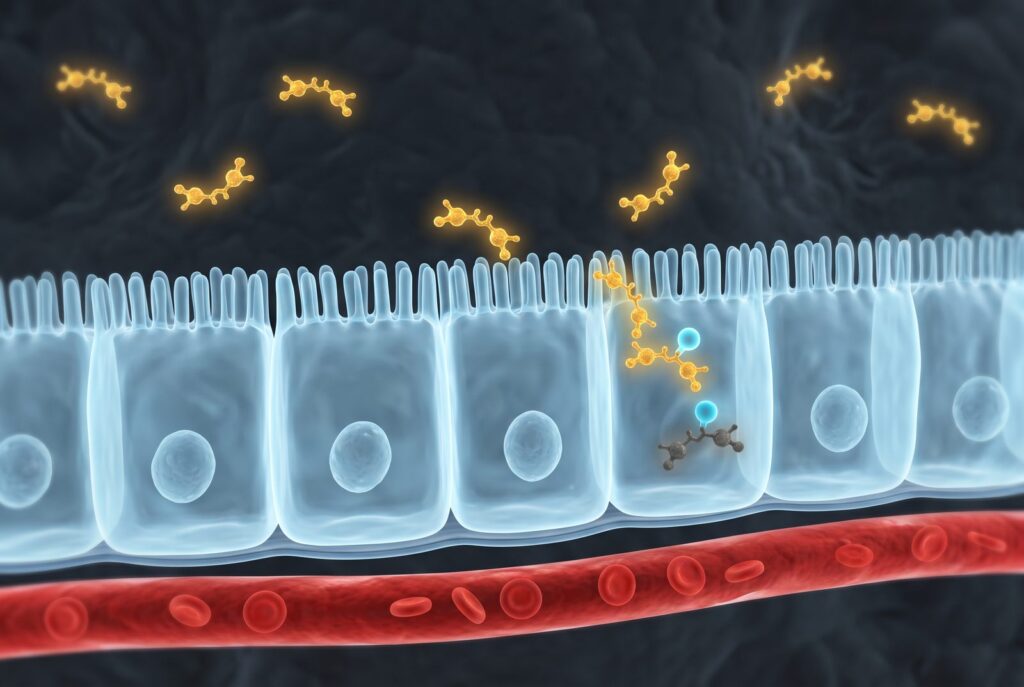
Piperine interferes with the clearance steps. It slows the enzymes that attach sugar groups to curcumin in the gut wall and the liver, the reaction that normally tags it for disposal. Less tagging means more free curcumin, for longer.
Shoba and colleagues measured it directly in 1998. Ten healthy volunteers took 2 g of curcumin alone, then the same 2 g with 20 mg of piperine. Curcumin alone was barely detectable. With piperine, the area under the concentration curve rose by 2,000 percent, and the peak arrived sooner.
The increase in curcumin bioavailability measured in healthy volunteers when 20 mg of piperine was taken alongside 2 g of curcumin.
Shoba et al., Planta Medica, 1998
What the figure does not mean
Two thousand percent sounds enormous because the starting point is almost nothing. Twenty times a very small number is still a modest number. Piperine moves curcumin from undetectable to measurable. Read it as a floor being raised, not a ceiling broken. Curcumin is not alone in this: quercetin is absorbed just as poorly, and its labels are just as quiet about it.
How much black pepper do you actually need?
The ratio in the Shoba study is the one the whole supplement industry copied: 20 mg of piperine for 2 g of curcumin, roughly one part piperine to a hundred parts curcumin. Since piperine is about 5 percent of black pepper by weight, 20 mg of piperine is around 400 mg of ground pepper, which is a generous pinch rather than a spoonful.

In cooking, you do not need to weigh anything. A few grinds over a curry, a dhal or a warm milk drink is already in the right territory, and the fat in the dish helps too, because curcuminoids dissolve in fat rather than water. In a capsule, the number is printed on the pack, usually as BioPerine or as a standardised piperine content.
HOW MUCH PEPPER, AND WHAT IT BUYS YOU
Piperine is not the only way
Piperine is the oldest solution to the absorption problem, not the only one. Phospholipid complexes, micellar liquids and cyclodextrin formulations raise blood levels by different routes, and some do it more. A pack carrying one of those and no pepper has simply solved the same problem another way. Our own bioavailable anti inflammatory formula was built around exactly that question of what actually reaches the bloodstream.
What the pairing has actually been tested for
Almost all of the clinical evidence sits in one place: joint pain, and knee osteoarthritis in particular. That is where the trials were run, so that is what can honestly be said. Tendon pain is not in that evidence base: there the tested treatment is the loading programme itself, not the capsule.
Daily and colleagues pooled the randomised trials in 2016. Across the studies reporting a pain visual analogue score, turmeric extract beat placebo by a mean difference of 2.04 points, and across four studies the WOMAC score fell by 15.36 points. The effective dose was around 1,000 mg of curcumin a day. In five studies, the difference against conventional pain medication was not statistically significant.
Bannuru and colleagues repeated the exercise in 2018 across 11 trials and 1,009 patients, putting curcuminoids and boswellia on the same ground, the other resin with a comparable trial record. Curcuminoids again outperformed placebo on pain and function. Against non steroidal anti inflammatories they matched on efficacy, and patients taking curcuminoids reported significantly fewer gastrointestinal side effects. Both reviews flag the same weakness: small trials, low methodological quality, and short follow up.
WHAT THE POOLED TRIALS FOUND, KNEE OSTEOARTHRITIS
If your reason for opening this article is an aching knee or stiff fingers rather than general wellbeing, the osteoarthritis formula is the page that covers that ground properly, dose included. If it is general wellbeing rather than one joint, the honest instrument is a high-sensitivity CRP read twice, eight weeks apart, rather than how you feel in week two.
How to read a turmeric and black pepper label in the UK
Turmeric capsules on a British high street are sold as food supplements. They sit under food law, not medicines law, and no health claim about curcumin has been authorised for use on a GB pack. That is why the wording on the front tends to stop at “joint health” or “immune support” carried by an added vitamin, not by the turmeric itself.
There is a separate route. A manufactured herbal product can hold a Traditional Herbal Registration from the MHRA, which shows on the pack as a THR number and logo, and which allows a defined traditional use claim. Most turmeric products you will meet are food supplements rather than THR products, so the THR logo is a genuine point of difference when you see one.
| On the pack | What it tells you | What to check next |
|---|---|---|
| Turmeric 500 mg | Weight of root powder, not of curcumin | Look for a stated curcuminoid percentage |
| Curcumin extract 95% | A concentrated extract, the form used in trials | Multiply out to a daily curcumin figure |
| BioPerine 5 mg | Standardised piperine, the Shoba mechanism | Check the curcumin dose it is paired with |
| Phytosome or micellar | Absorption solved without pepper | Compare on measured blood levels, not on pepper |
| THR number and logo | A registered traditional herbal medicine | Read the permitted traditional use statement |
What the guidance says about supplements and joints
NICE guideline NG226, which covers osteoarthritis in people over 16, puts therapeutic exercise at the centre of management and tells clinicians not to offer glucosamine. Curcumin does not appear in the guideline at all, in either direction. The same guideline governs the wear in the facet joints of the spine, where the answer is identical. So a GP working to NG226 will talk to you about loading the joint and about weight where it is relevant, and will treat a turmeric capsule as your decision rather than theirs.
Who should be careful, and what not to take it with
Piperine is useful precisely because it interferes with drug metabolism, and that mechanism does not stop at curcumin. The same enzymes handle a long list of prescription medicines, which is why a pepper enhanced supplement deserves a conversation your morning curry does not.

- On warfarin or another anticoagulant, or on antiplatelet medication: curcumin has its own mild effect on platelets, so raise it with whoever monitors your INR.
- On any regular prescription, particularly for epilepsy, transplant immunosuppression, HIV or heart rhythm: ask your pharmacist, because piperine can raise blood levels of drugs cleared by the same route.
- With gallstones or a blocked bile duct: curcumin makes the gallbladder contract.
- Before surgery: stop two weeks ahead, the standard advice for supplements that touch clotting.
- In pregnancy and breastfeeding: culinary amounts are food, concentrated extracts have not been studied, so the honest answer is to stay with the spice.
- With iron supplements: curcumin binds iron in the gut, so separate the two by a couple of hours.
When to take it, and what to take it with
Timing matters less than company. Curcuminoids are fat soluble, so a capsule taken with a meal containing some fat is absorbed better than one swallowed with water on an empty stomach. Olive oil, yoghurt, nuts, oily fish, whole milk: any of them will do.
Split the day rather than front load it. Curcumin clears quickly even with piperine, so two smaller doses hold a steadier level than one large morning dose. And give it time: in the trials that showed an effect, the assessment points were at four, six and eight weeks. A fortnight of capsules is not a trial of anything. If you mean to judge it on a marker rather than on how you feel, take the baseline before you start, which is the one discipline self-experimentation gets right when it gets anything right.
Frequently asked questions
What does taking turmeric and black pepper do?
The black pepper raises how much curcumin from the turmeric reaches your bloodstream, by slowing the enzymes that would otherwise clear it. On its own, curcumin is poorly absorbed. Pooled trials of turmeric extract at around 1,000 mg of curcumin a day show reduced pain and better function in knee osteoarthritis compared with placebo.
How much black pepper do you need with turmeric?
The reference study used 20 mg of piperine with 2 g of curcumin, about one part to a hundred. Since piperine is roughly 5 percent of black pepper, that is around 400 mg of ground pepper, a generous pinch. In cooking, a few grinds over the dish is enough. In a capsule the amount is printed on the pack.
Who cannot take turmeric and black pepper?
Speak to a pharmacist first if you take warfarin or another anticoagulant, if you have gallstones or a blocked bile duct, if you are pregnant or breastfeeding, or if you take regular prescription medicine. Stop concentrated supplements two weeks before planned surgery. Culinary amounts in food are not the concern here.
What should you never mix with turmeric?
The interactions worth knowing are anticoagulants and antiplatelets, and any medicine cleared by the liver enzymes that piperine slows, which includes some epilepsy, immunosuppressant and heart rhythm drugs. Keep iron supplements a couple of hours apart, because curcumin binds iron in the gut.
What is the best time of day to take turmeric and black pepper?
With a meal containing some fat, because curcuminoids dissolve in fat rather than water. Splitting the daily amount between two meals holds a steadier blood level than one large dose, since curcumin clears quickly even with piperine.
Do all turmeric supplements need black pepper?
No. Piperine is the oldest fix for curcumin’s poor absorption, not the only one. Phospholipid complexes, micellar liquids and cyclodextrin formulations raise blood levels by other routes, and some do so more. Judge a pack on the absorption data behind it, not on whether pepper appears in the list.
Sources
Shoba G., Joy D., Joseph T., Majeed M., Rajendran R., Srinivas P.S. (1998). Influence of piperine on the pharmacokinetics of curcumin in animals and human volunteers. Planta Medica, 64(4), 353-356. DOI: 10.1055/s-2006-957450
Anand P., Kunnumakkara A.B., Newman R.A., Aggarwal B.B. (2007). Bioavailability of curcumin: problems and promises. Molecular Pharmaceutics, 4(6), 807-818. DOI: 10.1021/mp700113r
Daily J.W., Yang M., Park S. (2016). Efficacy of turmeric extracts and curcumin for alleviating the symptoms of joint arthritis: a systematic review and meta-analysis of randomized clinical trials. Journal of Medicinal Food, 19(8), 717-729. DOI: 10.1089/jmf.2016.3705
Bannuru R.R., Osani M.C., Al-Eid F., Wang C. (2018). Efficacy of curcumin and Boswellia for knee osteoarthritis: systematic review and meta-analysis. Seminars in Arthritis and Rheumatism, 48(3), 416-429. DOI: 10.1016/j.semarthrit.2018.03.001
Robinson W.H., Lepus C.M., Wang Q. et al. (2016). Low-grade inflammation as a key mediator of the pathogenesis of osteoarthritis. Nature Reviews Rheumatology, 12(10), 580-592. DOI: 10.1038/nrrheum.2016.136


