
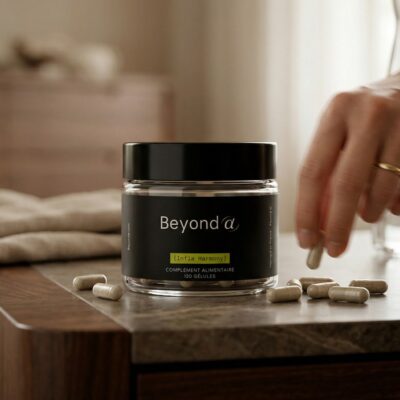


Boswellia serrata is an Indian tree resin whose boswellic acids block 5-lipoxygenase, an inflammatory enzyme that ordinary anti-inflammatory drugs leave untouched. In knee osteoarthritis, seven placebo-controlled trials show a genuine reduction in pain and stiffness, provided you use a standardised extract and stay on it for at least eight weeks.
Here is the point most pages skip. Two supplements sold under the same name can differ tenfold in how much active material they contain. Choosing the extract matters more than choosing the brand.
What boswellia serrata actually is
Boswellia serrata is a tree of the Burseraceae family that grows in the dry regions of central India, from Gujarat across to Bengal. Cut the bark and it weeps a gum resin that hardens in the air into small amber tears. That resin, and only that resin, is what goes into the capsules. Ayurvedic medicine has used it for centuries under the name salai guggul, for joint pain and for breathing problems, which is why the first clinical trials were run in India in the 1990s and 2000s.

The commonest confusion is with frankincense. The resin burned in churches usually comes from Boswellia sacra or Boswellia carterii, harvested in the Arabian peninsula and the Horn of Africa. Botanical cousins, not the same plant, and in any case burning destroys the compounds you want. No incense stick has ever helped a knee.
How boswellic acids work
The resin contains a dozen or so triterpenes known as boswellic acids. The most studied has an unpronounceable name, 3-O-acetyl-11-keto-beta-boswellic acid, which everyone shortens to AKBA. It makes up a minority of the raw resin, often under 2 per cent, which is precisely why serious manufacturers concentrate their extracts.
These compounds inhibit 5-lipoxygenase. That enzyme converts arachidonic acid into leukotrienes, messengers that pull white cells towards inflamed tissue, make blood vessels leakier and keep pain going. It is a different inflammatory route from the prostaglandin pathway.
The distinction has a practical consequence. Ibuprofen and the other non-steroidal anti-inflammatory drugs act on the cyclooxygenases, and it is that blockade which thins the protection of the stomach lining. Boswellia goes through the other door. That does not make it free of side effects, and we come back to that below, but it does explain the generally better digestive tolerance reported in the trials.
One secondary property is worth flagging. Several laboratory studies describe an effect of boswellic acids on matrix metalloproteinases, the enzymes that break cartilage down, the same ones that dismantle the collagen scaffold cartilage is built on. The idea of a structural effect, on top of a symptomatic one, is open. No clinical trial has yet shown slower cartilage loss in a human being, and anyone telling you otherwise is selling.
Osteoarthritis: the evidence, with its limits
participants across the seven placebo-controlled trials that make up the entire clinical evidence base for boswellia in osteoarthritis.
Yu G. et al., BMC Complementary Medicine and Therapies, 2020
That is the number to hold in your head before reading anything else about this plant. Seven trials, 545 participants in total. The evidence base exists, it is consistent, and it is small. A synthetic drug reaches the market after trials that usually recruit several thousand people.
The 2020 review published in BMC Complementary Medicine and Therapies pooled those seven studies, all placebo-controlled, all in osteoarthritis and mostly of the knee. This is what it measured.
Effect measured against placebo in the 2020 meta-analysis
A shift of 14 points on the WOMAC pain sub-score is not a rounding error. It is the order of magnitude you notice across a day: less bother going down the stairs, a less stiff first hour after getting up. What supplement labels call joint comfort corresponds to roughly that, and to no more than that. It is not the effect of a full-dose anti-inflammatory during an acute flare, and nobody should present it as one.
The most quoted trial inside that set appeared in Phytomedicine in 2003. Thirty patients with knee osteoarthritis received either the extract or a placebo, then swapped over. On boswellia, pain fell, knee flexion increased and walking distance went up. A crossover design, where each patient is their own control, removes the noise between individuals. The number of patients, on the other hand, is tiny.
A broader review, published in 2018 in Seminars in Arthritis and Rheumatism, compared curcumin-based and boswellia-based products on the same ground. Its conclusion deserves quoting as it stands: both reduce pain and improve function relative to placebo, but the available body of work is neither large enough nor rigorous enough to support a clinical recommendation. A clear signal, in other words, on incomplete proof.
It is worth being explicit about where that leaves you in the UK. The NICE guideline on osteoarthritis, updated in 2022, recommends therapeutic exercise and weight management as the core of treatment, whether the worn joint is in the hand, in the foot or in the facet joints of the spine, and specifically tells clinicians not to offer glucosamine or chondroitin. Boswellia is not mentioned at all, because guideline committees work from evidence at a scale this plant does not yet have. That is not the same as a verdict against it. It does mean a supplement sits alongside the exercise, never instead of it.
The bowel: a reasonable idea on thin evidence
Leukotrienes have a documented role in inflammation of the intestinal lining, so the hypothesis that a 5-lipoxygenase inhibitor might help inflammatory bowel disease is not fanciful. Two small older studies tested boswellia extracts in ulcerative colitis and in Crohn’s disease and reported encouraging results.

Read the small print. Each enrolled a few dozen patients, the follow-up was short, and a later and better-designed study in Crohn’s disease failed to separate the extract from placebo on maintenance of remission. This is a plausible lead that has not been confirmed. If you have colitis, boswellia is a conversation to have with your gastroenterologist, not a substitute for the drug that is keeping you in remission.
Asthma: one trial, from 1998
A trial run in 1998 in patients with asthma reported improved symptoms and improved lung function measurements. Again the mechanism makes sense: leukotrienes drive bronchoconstriction, to the point that an entire class of asthma medicines exists to block them.
But a single study of around forty people is not an indication. Asthma is a condition where undertreatment kills, and nobody should replace a preventer inhaler with a resin capsule. If you want to try it alongside your usual treatment, tell your asthma nurse.
Dose and form: where most buyers go wrong
This is the part where money gets wasted, not through carelessness but because the label is genuinely confusing. Two bottles can both announce 500 mg of Boswellia serrata and contain quantities of boswellic acids that are not remotely comparable.

| What the label says | What you are actually getting | Verdict |
|---|---|---|
| “Boswellia serrata 500 mg”, nothing else | Ground raw resin. Boswellic acids typically under 10 per cent, so perhaps 40 mg a capsule | Cheapest per capsule, and nothing like the trial doses |
| “Extract standardised to 65 per cent boswellic acids” | A 300 mg capsule delivers about 195 mg of boswellic acids | This is the form used in most of the published trials |
| “Standardised to 30 per cent AKBA” | Enriched in the single most active acid, so the daily dose is much smaller | 100 to 250 mg a day is normal here. A low number is not a weak product |
| “Frankincense”, no botanical name | Could be Boswellia sacra or carterii, the incense species, not serrata | Different plant, no trial data. Put it back |
The reasoning to apply, bottle in hand, is straightforward: what counts is not the weight of powder but the quantity of boswellic acids actually delivered per day. An extract standardised to 65 per cent gives you 195 mg from a 300 mg capsule. An unstandardised raw resin might give you 30 mg, or less, and nothing on the box lets you find out. That arithmetic decides whether a plant extract does anything at all, and boswellia is not the only place it bites: quercetin has an absorption problem no label prints either.
Two rules of taking apply to every form. First, with a meal that contains some fat, because boswellic acids are fat-soluble and absorption drops sharply on an empty stomach. Second, continuously, every day, for at least eight weeks before you judge. Taking one on bad days makes no sense with this mechanism.
Side effects and safety
Most of what people report is digestive and mild: nausea, reflux, loose stools, a heavy stomach. Taking the capsule mid-meal usually settles it. Skin rashes have been described. Overall tolerance in the trials was good, and better than the comparator anti-inflammatory drug where one was included.
There is one signal that deserves more attention than the supplement pages give it. The LiverTox database maintained by the US National Institutes of Health, which happens to be the page ranking first in Britain for this search, records rare cases of clinically apparent liver injury associated with boswellia-containing products. Rare is the operative word, and several of those cases involved multi-ingredient formulas where the culprit is hard to pin down. It is still a reason to stop and get advice if you develop dark urine, pale stools, yellowing of the eyes or unexplained fatigue while taking it.
Do not take boswellia in pregnancy or while breastfeeding. There is no safety data, and traditional use in India specifically avoided it in pregnancy.
Interactions with medicines
Boswellic acids interact with several cytochrome P450 enzymes, the liver machinery that clears a great many drugs. In practice that means three groups of people should ask a pharmacist before starting.
If you take warfarin or another anticoagulant, boswellia may add to the effect. If you take an immunosuppressant after a transplant or for an autoimmune disease, blood levels can shift. And if you take any medicine with a narrow margin between the useful dose and the toxic one, lithium and some anti-epileptics among them, the same caution applies. A community pharmacist will check this in two minutes and it is free.
How it is regulated in Britain
This matters more than it sounds, because it tells you what a label is allowed to say. Herbal products sold in the UK fall into two very different categories. A registered herbal medicine carries a Traditional Herbal Registration number from the MHRA, a THR code printed on the box, and comes with an approved patient information leaflet. Everything else is sold as a food supplement under food law.
Boswellia capsules on British shelves are, in practice, dietary supplements. That is not a criticism of the products, it is a description of the rules they sit under: a food supplement cannot make a medicinal claim, cannot say it treats arthritis, and is not assessed for efficacy before sale. So the wording on the front of the box tells you nothing useful about whether it works. The standardisation percentage on the back does.
Where it fits in a plan that works
Nothing in a capsule rebuilds cartilage or replaces the strength work that carries an arthritic knee, any more than it replaces the wider shoe that settles an inflamed bunion. What a well-standardised extract can reasonably do is take the edge off enough that the exercise becomes possible, and act on an inflammatory route that ibuprofen does not touch. That route is the same quiet, continuous one that a high-sensitivity CRP puts a number on, which makes it worth measuring before and after the eight weeks, provided the two numbers are read the way an honest self-experiment asks them to be read, as a trend rather than as a verdict. It has less to offer a tendon that has hurt for months, where there is very little inflammation left to act on.

That is also the argument for combining it rather than choosing between plant extracts. Curcumin and boswellic acids block different enzymes, which is why our bioavailable natural anti-inflammatory uses both rather than a large dose of one, and why the osteoarthritis formulation is built around standardised extracts at trial-level doses rather than around a big number on the front of the bottle.
Frequently asked questions
What is Boswellia serrata good for?
The only use supported by placebo-controlled trials in people is knee osteoarthritis, where seven small studies show a real reduction in pain and stiffness. Everything else you will read about it, bowel disease, asthma, skin, brain health, rests on a handful of small studies or on cell work. Those are reasonable leads. They are not established benefits.
Which is better for joint pain, turmeric or Boswellia?
A 2018 review in Seminars in Arthritis and Rheumatism put both through the same filter and found them broadly comparable: each beats placebo on pain and function, and neither has an evidence base large enough to justify a clinical recommendation. They also work through different enzymes, curcumin mainly on cyclooxygenase pathways and boswellic acids on 5-lipoxygenase, which is the usual argument for taking them together rather than choosing.
What are the negative side effects of Boswellia?
Most reported side effects are digestive: nausea, reflux, loose stools, stomach discomfort, generally mild and often settled by taking the capsule with a meal. Skin rashes have been described. More seriously, the NIH LiverTox database records rare cases of liver injury linked to boswellia-containing products, which is a reason to stop and seek advice if you develop dark urine, yellowing of the eyes or unexplained fatigue.
Who should not take Boswellia serrata?
Do not take it in pregnancy or while breastfeeding, where there is no safety data at all. Avoid it if you have liver disease. Speak to your GP or pharmacist first if you take warfarin or another anticoagulant, if you are on immunosuppressants, or if you take any drug with a narrow therapeutic window, because boswellic acids interact with several of the liver enzymes that clear medicines.
How long does boswellia take to work?
Nothing in the first week. A measurable difference from the second or third week, building to around week eight. Anyone who stops after ten days and concludes the product does nothing has not given the mechanism time to show itself. Judge it at eight weeks of continuous daily use, not before.
Does boswellia help ulcerative colitis or Crohn’s disease?
The idea is biologically reasonable, because leukotrienes are involved in inflammation of the gut lining and that is exactly what boswellic acids block. Two small older trials in ulcerative colitis and Crohn’s disease reported encouraging results, but each enrolled only a few dozen patients and later work has not confirmed them. Nobody should swap an established inflammatory bowel disease treatment for a resin capsule.
What to take away
Turn the bottle over before you buy. If the box does not tell you what percentage the extract is standardised to, you cannot know what you are taking, and the odds are you are taking very little. Look for 65 per cent boswellic acids, or an AKBA-enriched extract at 100 to 250 mg a day.
Then give it eight weeks, take it with food, and keep your expectations calibrated to what 545 people in seven trials actually showed: a real, moderate reduction in pain and stiffness. Not a cure, not a cartilage repair, and not a replacement for the exercise that does the structural work.
Sources
Yu G., Xiang W., Zhang T. et al. (2020). Effectiveness of Boswellia and Boswellia extract for osteoarthritis patients: a systematic review and meta-analysis. BMC Complementary Medicine and Therapies, 20, 225. DOI: 10.1186/s12906-020-02985-6
Kimmatkar N., Thawani V., Hingorani L., Khiyani R. (2003). Efficacy and tolerability of Boswellia serrata extract in treatment of osteoarthritis of knee, a randomized double blind placebo controlled trial. Phytomedicine, 10(1), 3-7. DOI: 10.1078/094471103321648593
Bannuru R.R., Osani M.C., Al-Eid F., Wang C. (2018). Efficacy of curcumin and Boswellia for knee osteoarthritis: systematic review and meta-analysis. Seminars in Arthritis and Rheumatism, 48(3), 416-429. DOI: 10.1016/j.semarthrit.2018.03.001
Robinson W.H., Lepus C.M., Wang Q. et al. (2016). Low-grade inflammation as a key mediator of the pathogenesis of osteoarthritis. Nature Reviews Rheumatology, 12(10), 580-592. DOI: 10.1038/nrrheum.2016.136
Sanchez-Lopez E., Coras R., Torres A. et al. (2022). Synovial inflammation in osteoarthritis progression. Nature Reviews Rheumatology, 18(5), 258-275. DOI: 10.1038/s41584-022-00749-9


