


A bunion flare is inflammation of the soft tissue over the joint, not growth of the bone. Remove the pressure with a wide flat shoe, ice the prominence, pad the skin, and most flares settle within a few days to two weeks. Sudden redness and heat over hours points to gout instead.
The distinction no page ranking for this makes: the base of the big toe is the commonest site of gout in the body. Same joint, same swelling, different treatment.
What is actually flaring
The bunion itself is a change in bone alignment: the first metatarsal drifts inwards, the big toe outwards, and the joint between them becomes prominent on the inner edge of the foot. That happens over years and does not fluctuate.
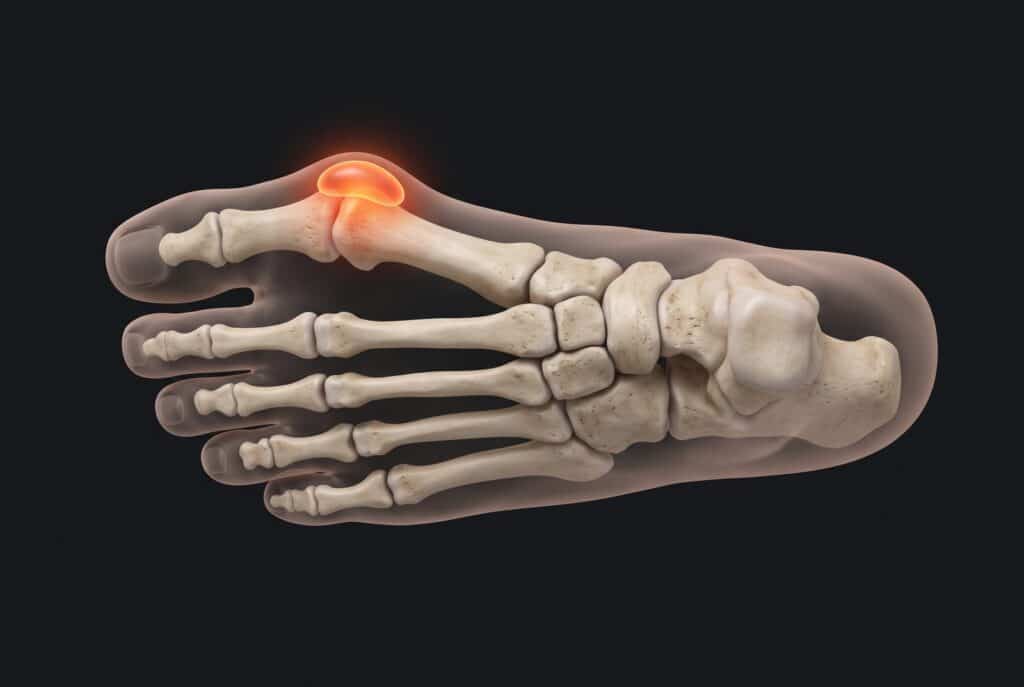
What fluctuates is everything sitting over it. A bursa, the same kind of small fluid filled cushion that inflames on the inner side of the knee, develops between the bony prominence and the skin, and swells when compressed repeatedly. That is the flare, and it explains the timing: bad after a wedding, fine after a fortnight in sandals.
How to calm a bunion flare up
Change the shoe today, not next week
Anything narrow or heeled keeps the pressure on. A wide, soft, flat shoe or a strapped sandal removes the cause in one step.
Ice the prominence, not the whole foot
Fifteen minutes with a wrapped cold pack over the swollen area, two or three times a day. This is bursitis, and cold works well on it.
Protect the skin
A gel pad stops the shoe rubbing the inflamed tissue. Cheap, immediate, and the step most people skip.
Anti-inflammatory, briefly
A short course, or a topical gel over the joint. It manages the flare, and is not a plan for the bunion.
Keep the toe moving
Bend and straighten the big toe gently, several times a day, once the sharpest pain settles. A joint that stops moving stiffens quickly.
Not every painful bunion is a bunion flare
How worried to be, by how it came on
in tight shoes
eases overnight
over several days
bursitis
within hours
gout or infection
Speed of onset is the clue that matters most. A mechanical flare builds over hours to days and tracks what you did. Gout arrives over a few hours, is disproportionately severe, and makes the joint red, hot and exquisitely tender, to the point where the weight of bedding is unbearable.
Gout attacks this joint more than any other, and bunion pain of that kind is regularly dismissed as the bump getting worse. See a GP rather than buying a wider shoe: gout has a specific treatment and repeated attacks damage the joint. A whole toe swollen along its length, or several joints flaring at once in someone whose back has been stiff every morning for months, points instead towards inflammatory arthritis.
A further possibility is that the joint is not the source at all: pain running along the top of the foot or the inner arch is a tendon problem, and it answers to lacing and loading rather than to width. The third possibility is hallux rigidus, osteoarthritis of the same joint. It gives stiffness more than swelling, hurts on push off rather than where the shoe rubs, and a stiff sole helps it where a wider one does not.
| What it is | How it behaves | What to do |
|---|---|---|
| Mechanical flare | Sore after shoes or walking, better with rest | Wider shoe, padding, ice |
| Bursitis over the bunion | Puffy, warm, tender to touch, builds over days | Remove all pressure, ice, anti-inflammatory |
| Gout | Red, hot, severe within hours, bedsheet unbearable | GP appointment, blood test, specific treatment |
| Hallux rigidus | Stiff rather than swollen, worse pushing off | Stiff soled shoe, not a wider one |
What actually prevents the next one
Footwear does most of the work: wide across the forefoot, low heeled, soft where the prominence sits. Most people with painful bunions are wearing shoes narrower than their own forefoot, and a foot and ankle clinic will say so in the first minute.

Padding and toe spacers make the joint more comfortable, and it is worth being clear that they do not straighten anything. In the only randomised trial to compare the options, an orthosis outperformed doing nothing over the first six months, while surgery gave the best pain outcomes at one year. Neither the orthosis nor the exercises changed the underlying angle.
If the joint stays inflamed between flares, the general picture matters too. Judge a bioavailable anti-inflammatory formula on how much active compound is actually absorbed rather than on the label dose, and treat anything sold for worn joints as support alongside the footwear change rather than instead of it. The shoe is still the intervention with the largest effect.
When to see someone
- Sudden redness, heat and severe pain over a few hours, particularly with fever. Same day GP appointment.
- A flare that has not improved after two weeks of wide shoes, padding and ice.
- Numbness, tingling or a burning line running into the toes.
- Any foot problem if you have diabetes, where skin breakdown over a bunion needs prompt attention.
- Pain that is stopping you walking normally or working, which is the threshold at which surgery is discussed.
Frequently asked questions
Why is my bunion suddenly so painful?
Usually because the tissue over the joint has become inflamed rather than because the bunion has changed. A bursa sits between the bony prominence and the skin, and pressure from a narrow shoe, a long day standing or a new pair of trainers makes it swell. Sudden severe pain with redness and heat over a few hours points to gout or infection instead.
What causes bunions to flare up?
Pressure and load. Narrow or pointed shoes, heels, a long walk, standing all day, a heavier training week, or a change in surface. Weight gain increases the load through the joint. Behind all of them sits one mechanism: the joint takes more force than usual and the soft tissue over it reacts.
How do you calm a bunion flare up?
Take the pressure off first, which means changing to a wide, flat, soft shoe or a strapped sandal immediately. Ice the prominence for fifteen minutes two or three times a day, pad the area, and use a short course of anti-inflammatory if you need it. Keep the big toe moving gently once the sharpest pain has gone.
How long do bunion flares last?
Most settle within a few days to two weeks once the pressure is removed. Bursitis that has been building for a while takes longer, sometimes three or four weeks. A flare that has not improved after a fortnight of proper footwear changes should be reassessed by a GP or a foot and ankle specialist.
Can a bunion flare up go away on its own?
The flare can, and usually does. The bunion cannot: hallux valgus is a change in the alignment of the bones, and nothing non-surgical straightens it. Splints, toe spacers and exercises make the joint more comfortable without correcting the angle. Worth knowing before you spend money.
Will the NHS operate on my bunion?
Only for pain and functional problems, not for appearance. It is available where the joint is genuinely painful and non-surgical measures have been tried, though access varies by area and waits are long. In the one randomised trial comparing surgery, an orthosis and waiting, surgery gave the best pain outcomes at a year.
What shoes should I wear with a bunion?
Wide across the forefoot, soft over the prominence, and with a heel no higher than two or three centimetres. Measure both feet at the end of the day and buy for the wider one. If the pain is on pushing off rather than at the bump, a stiff sole helps more than extra width.
What to take away
Do one thing tonight: draw round your foot on a sheet of paper, then stand the shoe you wore today on the outline. If the shoe is narrower, you have found the flare.
Sources
Torkki M., Malmivaara A., Seitsalo S. et al. (2001). Surgery vs orthosis vs watchful waiting for hallux valgus: a randomized controlled trial. JAMA, 285(19), 2474-2480. DOI: 10.1001/jama.285.19.2474
Robinson W.H., Lepus C.M., Wang Q. et al. (2016). Low-grade inflammation as a key mediator of the pathogenesis of osteoarthritis. Nature Reviews Rheumatology, 12(10), 580-592. DOI: 10.1038/nrrheum.2016.136
Sanchez-Lopez E., Coras R., Torres A. et al. (2022). Synovial inflammation in osteoarthritis progression. Nature Reviews Rheumatology, 18(5), 258-275. DOI: 10.1038/s41584-022-00749-9
Wu R., Peng Q., Wang W. et al. (2024). Systematic review and network meta-analysis on the efficacy and safety of pharmacotherapy for hand osteoarthritis. PLOS ONE, 19(4), e0298774. DOI: 10.1371/journal.pone.0298774
Musorrofiti M.G., Bonifacio M., Cipolloni V. et al. (2026). The use of physical energy-based therapies in the management of osteoarthritis. Medicina, 62(6), 1119. DOI: 10.3390/medicina62061119


