



Wintergreen is the essential oil most used for tendonitis: its methyl salicylate, a cousin of aspirin, warms the skin and dulls pain for a few hours. Lemon eucalyptus, helichrysum and lavender have never been tested on a human tendon. No essential oil repairs a tendon, and wintergreen is off limits if you take an anticoagulant.
You have tendonitis in the elbow, shoulder or heel, and someone has suggested a bottle of wintergreen. Before you open it, three questions deserve an honest answer. What does this oil actually do? How much should you use? And who must not use it at all? The pages praising these oils answer the second question well, and rarely the other two.
What is tendinopathy, and what can an oil reach?
The word tendonitis promises an inflammation to put out. Painful tendons taken from patients during surgery tell another story: few inflammatory cells, and a great many disorganised collagen fibres. As early as 2002, an editorial in the British Medical Journal proposed dropping the term in favour of tendinopathy.

So after the first few weeks, an oil sold as anti-inflammatory targets something that has largely gone, and it does not reach the core of the tendon in useful amounts. That does not mean it does nothing.
Three mechanisms explain the relief many people feel. Counter-irritation comes first: wintergreen warms, peppermint cools, and that skin signal scrambles the pain message for a while. Then there is the massage, which relaxes the muscles around the tendon. Finally, the ritual itself gives the tendon two or three pauses a day. None of this is trivial, and none of it rebuilds a tendon.
Elbow, wrist, shoulder, heel: not every tendon is equally close to the skin
At the elbow and wrist, tendons run just under thin skin, so warmth or coolness is felt right over the sore spot, and an oil makes most sense there. The shoulder is the opposite case. The rotator cuff tendon lies under the deltoid muscle and a bony ledge of the shoulder blade, so no oil gets there, and the relief comes from the surface muscles you rub. At the heel, the Achilles tendon is close to the surface, but the shoe rubs exactly there: apply the blend in the evening, barefoot, rather than before putting on a closed shoe.
Is there an essential oil that reduces inflammation?
Lists of anti-inflammatory essential oils rely on laboratory and animal work. In humans, and on a tendon, the evidence is almost empty. The same names come up in every recipe; here is what each contains.
Wintergreen
About 98% methyl salicylate, a cousin of aspirin. Warming and pain-dulling. Reaches the bloodstream.
Lemon eucalyptus
Rich in citronellal. Calming and anti-inflammatory effects measured in rodents, never on a human tendon.
Frankincense
Distilled oil, with little or none of the boswellic acids studied in boswellia extracts. No tendon data.
Wintergreen, the only one whose active ingredient has been tested
Methyl salicylate is the ingredient of the warming rubs sold for muscle aches in British pharmacies. A Cochrane review pooled the trials of these salicylate rubs. In acute pain, mostly sprains and strains, about 3 people needed treating for one more to get relief than with a placebo; in chronic pain, about 6. The authors judged the evidence to be of very low quality, and the largest, most recent trials showed no effect at all.
By comparison, the best-studied diclofenac gel relieves one more person than placebo for fewer than 2 treated, in another Cochrane review of 61 studies on sprains and overuse injuries. The NHS advice on tendonitis also mentions an ibuprofen gel. If your tendonitis is recent and very painful, a gel like this, rather than wintergreen, has the better data.
Lemon eucalyptus, helichrysum and frankincense
A Brazilian team tested the oils of three eucalyptus species, lemon eucalyptus among them, in mice and rats in 2003. They reduced pain and swelling caused in the laboratory, unevenly depending on the dose: a clue, not proof for your elbow. Its practical appeal is good skin tolerance and no salicylates, which makes it the fallback when wintergreen is ruled out.
Helichrysum, also called immortelle, is mostly used on bruises and swelling after a knock, with no published study on tendons. Frankincense oil is often sold on the strength of boswellia research, but the boswellic acids studied in boswellia serrata extracts are not volatile, so a distilled essential oil contains little or none of them.
True lavender is the gentlest: relaxing, rarely irritating, a good addition to a salicylate-free blend. Peppermint gives an instant but short-lived chill through its menthol. It is unsuitable for children under 6 and not advised with epilepsy.
| Oil | Main molecule | What has been shown | Avoid if |
|---|---|---|---|
| Wintergreen | Methyl salicylate, about 98% | Weak and uncertain pain relief from salicylates rubbed on the skin | Anticoagulant, aspirin allergy, pregnancy, breastfeeding, children |
| Lemon eucalyptus | Citronellal | Anti-inflammatory effect in rodents | Reactive skin, pregnancy without medical advice |
| Helichrysum (immortelle) | Neryl acetate, italidiones | No data in humans | Pregnancy, breastfeeding, children |
| Frankincense | Monoterpenes such as pinene | No tendon data; boswellic acids are not volatile | Known fragrance allergy |
| True lavender | Linalool, linalyl acetate | Relaxing effect, studied mostly by inhalation | Known fragrance allergy |
| Peppermint | Menthol, menthone | Immediate, brief cooling | Children under 6, epilepsy, pregnancy |
Wintergreen: who should never use it
Recipes deal with this in one line, yet it matters most. Wintergreen oil is a concentrated salicylate that behaves in the body like aspirin.
WHAT HAPPENS TO WINTERGREEN AFTER YOU RUB IT IN
In 1990, a team in Hong Kong reported 11 patients on warfarin whose clotting had gone out of control after heavy use of a methyl salicylate ointment. All had measurable salicylate in their blood. Three bled: two with bruising, one with a gastrointestinal haemorrhage.

The neat oil is also a household hazard. At about 98% methyl salicylate, a single millilitre, some thirty drops, carries as much salicylate as nearly three 500 mg aspirin tablets. An emergency medicine review reports that in children under 6, a teaspoon, 5 ml, or less has been involved in several deaths. Store the bottle out of reach, like a medicine.
Do not use wintergreen, even diluted, if you are allergic or sensitive to aspirin or anti-inflammatories, take an anticoagulant or antiplatelet drug, have a bleeding disorder or surgery coming up, take aspirin regularly, or are pregnant or breastfeeding. Never use it on a child or teenager, and avoid it on broken skin, eczema or a large area.
Precautions for every oil
Nearly 80 essential oils have caused contact allergies, according to a 2016 dermatology review, mostly with neat or very concentrated oils. Hence three rules. Always dilute. Patch test in the crook of the elbow 24 hours before the first use. Stop at the first redness or itching. Oils rich in ketones or camphor, such as peppermint or camphor rosemary, can encourage seizures, so avoid them with epilepsy. In pregnancy, while breastfeeding and in children under 6, use no oil without advice from a doctor or pharmacist.
How to use essential oils for tendonitis safely
An essential oil is never applied neat. Dilute it in a carrier oil such as sweet almond. As a rule of thumb, one millilitre of essential oil equals about 25 to 30 drops depending on the dropper, so thirty drops in a 30 ml bottle gives a dilution of 3 to 4%, the usual range for local use in adults.
| For a 30 ml bottle | Blend with wintergreen | Salicylate-free blend |
|---|---|---|
| Carrier oil | Top up to 30 ml | Top up to 30 ml |
| Wintergreen | 12 drops | None |
| Lemon eucalyptus | 12 drops | 15 drops |
| Helichrysum | 6 drops | None |
| True lavender | None | 10 drops |
| Resulting dilution | About 3 to 4% | About 3% |
| Suitable for | Adults with no contraindication | Adults who cannot use salicylates, with their doctor’s agreement |
How you apply it matters as much as the recipe. Put 4 to 6 drops of the blend in your palm, spread them over an area no bigger than your hand, and massage gently for 1 to 2 minutes. Two to three applications a day are enough, for 7 days at most, followed by a break of at least a week. Wash your hands afterwards, especially before touching your eyes.

Two mistakes cancel out the care taken over dilution. Never cover the area with a tight bandage, a hot water bottle or a heat patch after applying it, because heat and occlusion push more salicylate into the blood. And do not rub it in just before exercise to mask the pain: you would load a tendon that was asking you to slow down.
The effect of an oil is judged in minutes, not weeks. If, after 7 days, your everyday pain has not moved, there is no point extending or doubling the dose. It is a sign to rethink the load on the tendon, with a physiotherapist if needed.
Should you massage tendonitis?
Yes, gently. Massage probably does most of the work when you apply an oil. Deep transverse friction, rubbing across the tendon fibres, was assessed in a 2012 review of 9 studies. On its own, its effectiveness has never been established. It showed some benefit at the elbow combined with a manipulation, and at the shoulder combined with joint mobilisation. If your pain sits on the outside of the elbow, our guide to tennis elbow covers what really works there.

What actually heals a tendon
A tendon rebuilds when it is reloaded gradually, not when it is protected. The reference approach, set out in our guide to Achilles tendinopathy exercises, transfers with adapted exercises to the elbow, shoulder or knee. What makes tendonitis worse is often what people do to relieve it: weeks of complete rest weaken the tendon, while a sudden return to effort, forced stretching and some fluoroquinolone antibiotics irritate it further.
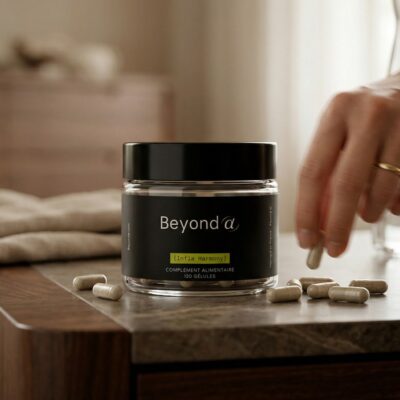
Essential oils therefore join the other comfort remedies, like the green clay poultice: useful for getting through a bad evening, with no effect on how long the tendonitis lasts. Sleep, enough protein and a contained background of inflammation support collagen repair, and that is the ground our tendon support supplement with Longvida curcumin and boswellia targets: 400 mg of Longvida curcumin, 307 mg of boswellia, and 300 mg each of ginger, quercetin and alpha-lipoic acid per day. It supports reloading without replacing it, and like wintergreen, it is not advised with an anticoagulant.
When to see a GP
Ordinary tendonitis can be managed at home for a few weeks. See a GP without waiting if the pain started suddenly with a snap, if the area is red, hot and swollen, especially with a fever, if pain lasts beyond 6 weeks despite sensible loading, or if the tendonitis began during or after a course of fluoroquinolone antibiotics. If the skin reddens, swells or blisters after applying an oil, wash it off with soap and water and ask a pharmacist. And if a child has swallowed any wintergreen oil, even a little, call 999 or go straight to A&E.
Frequently asked questions
Which essential oil is best for tendonitis?
None has been shown to heal a tendon. Wintergreen is the most used because its methyl salicylate dulls pain for a few hours, but its effect in trials is weak and it reaches the bloodstream. Lemon eucalyptus is the usual fallback when salicylates are off limits. An ibuprofen or diclofenac gel has much better evidence.
Can castor oil help with tendonitis?
There is no trial of castor oil on tendons. It is a thick vegetable oil, not an essential oil, and it works well enough as a carrier for massage. Any relief from a warm castor oil pack comes from the warmth, the massage and the rest, not from a proven action on the tendon itself.
What are some good herbs for ligaments and tendons?
No herb rebuilds a tendon; progressive loading does. Curcumin and boswellia extracts are the best studied plant actives for joint and tendon pain, with modest effects on pain. They may support recovery alongside exercises. Check with a pharmacist first if you take an anticoagulant or other regular medicines.
What vitamin deficiency causes tendonitis?
None on its own. Vitamin C is needed to make collagen, but a deficiency severe enough to matter is rare in the UK. Tendonitis almost always follows a change in load: more training, a new task, a return after a break. Some antibiotics of the fluoroquinolone family can also trigger it.
Sources
Khan K.M., Cook J.L., Kannus P., Maffulli N., Bonar S.F. (2002). Time to abandon the “tendinitis” myth. BMJ, 324(7338), 626-627. DOI: 10.1136/bmj.324.7338.626
Derry S., Matthews P.R.L., Wiffen P.J., Moore R.A. (2014). Salicylate-containing rubefacients for acute and chronic musculoskeletal pain in adults. Cochrane Database of Systematic Reviews. DOI: 10.1002/14651858.CD007403.pub3
Derry S., Moore R.A., Gaskell H., McIntyre M., Wiffen P.J. (2015). Topical NSAIDs for acute musculoskeletal pain in adults. Cochrane Database of Systematic Reviews. DOI: 10.1002/14651858.CD007402.pub3
Yip A.S.B., Chow W.H., Tai Y.T., Cheung K.L. (1990). Adverse effect of topical methylsalicylate ointment on warfarin anticoagulation: an unrecognized potential hazard. Postgraduate Medical Journal, 66(775), 367-369. DOI: 10.1136/pgmj.66.775.367
Davis J.E. (2007). Are one or two dangerous? Methyl salicylate exposure in toddlers. The Journal of Emergency Medicine, 32(1), 63-69. DOI: 10.1016/j.jemermed.2006.08.009
de Groot A.C., Schmidt E. (2016). Essential oils, part IV: contact allergy. Dermatitis, 27(4), 170-175. DOI: 10.1097/DER.0000000000000197
Joseph M.F., Taft K., Moskwa M., Denegar C.R. (2012). Deep friction massage to treat tendinopathy: a systematic review of a classic treatment in the face of a new paradigm of understanding. Journal of Sport Rehabilitation, 21(4), 343-353. DOI: 10.1123/jsr.21.4.343
Silva J., Abebe W., Sousa S., Duarte V., Machado M., Matos F. (2003). Analgesic and anti-inflammatory effects of essential oils of Eucalyptus. Journal of Ethnopharmacology, 89(2-3), 277-283. DOI: 10.1016/j.jep.2003.09.007


