


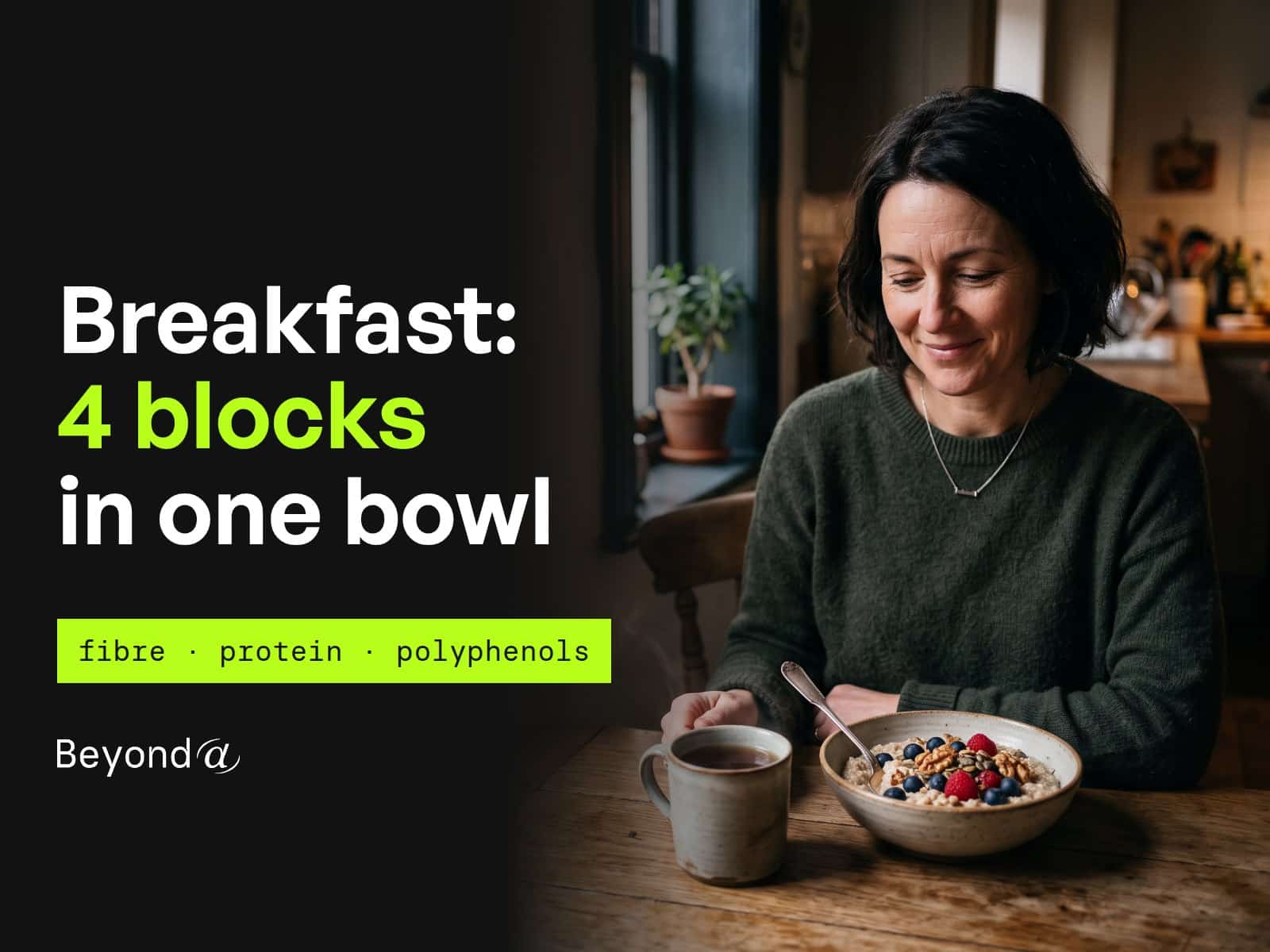
An anti-inflammatory breakfast combines four things: 8 to 10 g of fibre from wholegrains, omega-3 fats from ground flaxseed or walnuts, 15 to 20 g of protein, and polyphenols from berries, spices or green tea. It flattens the glucose and fat spike that follows every meal. In controlled trials the measurable effect on inflammatory markers is modest, and it shows up mainly in people whose markers were high to begin with.
You have probably read that porridge is anti-inflammatory and that a fry-up is not. Both statements are roughly true and both are far too vague to build a morning on. This article gives you the structure, the amounts, seven breakfasts that fit a British kitchen, and the numbers from the trials, including the ones that came out negative.
What makes a breakfast anti-inflammatory?
Every meal starts a postprandial phase, the four to six hours in which glucose and fats circulate before they are stored or burned. During that window the body produces a brief, entirely normal burst of inflammatory signalling. It is not a defect. It is how digestion works.

The problem is the height and the length of that burst. A breakfast of white toast and jam produces a tall, fast peak followed by a drop that leaves you hungry by eleven. A breakfast built on wholegrains, fat, protein and polyphenols produces a lower, longer curve. Repeat that difference across a decade of mornings and you are looking at two different metabolic trajectories.
That is the whole mechanism. Breakfast matters more than the other meals for a simple reason: it is the meal people eat most consistently, in a hurry, and often out of a packet chosen once and then bought on autopilot for years.
The four building blocks
ONE BREAKFAST, FOUR JOBS
INFLAMMATORY
BREAKFAST
FIBRE
8 to 10 g, from oats, wholemeal bread or wholegrain cereal. Flattens the glucose curve and feeds the gut bacteria that produce butyrate.
OMEGA-3 FATS
One tablespoon of ground flaxseed or three walnuts. The raw material the body uses to build resolving molecules.
PROTEIN
15 to 20 g. Two eggs give about 13 g, 150 g of Greek yogurt about 15 g. Holds appetite and blunts the peak.
POLYPHENOLS
Berries, cinnamon, green tea, cocoa. The specifically anti-inflammatory part of the plate.
Fibre
The NHS puts adult fibre intake at 30 g a day and most adults in the UK land well short of it. Breakfast is the easiest place to claw back a third of that gap.
Reynolds and colleagues published a series of systematic reviews in The Lancet in 2019 covering just under 135 million person-years of data. Comparing the highest fibre consumers with the lowest, they found a 15 to 30 % lower rate of all-cause and cardiovascular mortality, of coronary heart disease, of type 2 diabetes and of colorectal cancer. The benefit was greatest at intakes between 25 g and 29 g a day.
Aim for 8 to 10 g at breakfast. Fifty grams of rolled oats gives about 5 g. A tablespoon of chia adds around 5 g on its own. A slice of proper wholemeal sourdough gives 3 g. Whole fruit, not juice: juicing removes the fibre and leaves the sugar.
Omega-3 fats
Omega-3 fatty acids are the precursors of the molecules that actively shut inflammation down once it has done its job. The body cannot make them. One tablespoon of freshly ground flaxseed carries roughly 2 g of alpha-linolenic acid, the plant form. Three walnuts do a similar job. Buy flaxseed whole and grind it yourself: ground linseed oxidises within weeks and loses most of its point.
Half an avocado on toast is not an omega-3 source, whatever the caption says. It is monounsaturated fat, which is fine, and it belongs in a good breakfast for other reasons. It just does not do this particular job.
Protein
Fifteen to twenty grams is the target, and it is the block most often missing from a British breakfast. Two eggs give about 13 g. A 150 g pot of Greek yogurt or skyr gives about 15 g. A 30 g handful of almonds gives about 6 g. A bowl of cereal with semi-skimmed milk gives you perhaps 8 g, which is why you are hungry an hour later.
Polyphenols
This is the block that does the specifically anti-inflammatory work, and it is the cheapest to add. A handful of berries, frozen is fine and often better. A pinch of cinnamon. Green tea instead of the second builder’s tea. Unsweetened cocoa in a smoothie. They are the domestic end of the foods that carry a real antioxidant load, and none of them will transform anything on its own. Turmeric is the exception worth naming, because a pinch stirred into oats sits nowhere near the amounts that were tested, and even paired with black pepper the arithmetic stays awkward. Together, every morning, they are the difference between a bowl of carbohydrate and a meal.

Are Weetabix anti-inflammatory?
This question comes up often enough that Google puts it in the box under the search bar, so here is a direct answer. Two Weetabix are made from wholegrain wheat, give you roughly 3 to 4 g of fibre and contain very little added sugar. On those two counts they are a reasonable base, and better than most of the cereal aisle.
They are not, by themselves, an anti-inflammatory breakfast. Two biscuits and cold milk supply one of the four blocks and about half of what you need of it. What turns them into a proper meal is what you put on top: a tablespoon of ground flaxseed, a handful of berries, and either a pot of Greek yogurt alongside or milk replaced with something that carries more protein.
The wider point about the cereal aisle is worth ten minutes of your time once. Turn the box round and read two lines. Fibre per 100 g: below 6 g and it is not a wholegrain product in any meaningful sense, whatever the front of the pack says. Sugars per 100 g: many granolas sit above 20 g, which puts them closer to a biscuit than to porridge. Honey, agave and date syrup all count in that line.
The full English, and what to leave off the plate
A cooked breakfast is not a single food and it does not deserve a single verdict. Taken apart, most of it is defensible and two or three items are not.

| On the plate | Verdict | Why |
|---|---|---|
| Poached or scrambled eggs | Keep | Protein, and the block a British breakfast usually gets right |
| Grilled tomatoes, mushrooms | Keep | Polyphenols, no downside |
| Baked beans | Keep, with a caveat | Genuinely high in fibre; a standard tin also carries about 4 to 5 g of sugar and 0.5 g of salt per half tin |
| Wholemeal or sourdough toast | Keep | Fibre; white sliced does not do the same job |
| Bacon and sausages | Occasional | Processed meat, saturated fat and salt; the frequency is the issue, not the single plate |
| Fried bread, hash browns | Drop | Refined starch cooked in fat, nothing else |
| Orange juice | Drop | A 200 ml glass carries the sugar of several oranges with none of the fibre |
Three things do more damage than a weekend fry-up because they happen every day: a pastry eaten standing up, a bowl of sweetened granola, and fruit juice treated as one of your five a day. Add one line of that table to another and you can reach the daily free-sugar limit before nine in the morning.
Seven breakfasts that tick all four boxes
Each of these hits fibre, fats, protein and polyphenols. Quantities are for one person.
1. Berry porridge, the reference version. 50 g rolled oats, 200 ml unsweetened milk of your choice, 1 tbsp chia, 1 tbsp ground flaxseed, a handful of blueberries and raspberries, 3 crushed walnuts, a pinch of cinnamon. Simmer the oats for five minutes, take off the heat, stir in the seeds and let them swell for three minutes, then add fruit and nuts. Cinnamon last, so the flavour survives.
2. Avocado and egg on toast. One thick slice of wholemeal sourdough, half an avocado, a poached egg, a squeeze of lemon, a teaspoon of ground flaxseed, black pepper. The savoury option, and the fastest way to 18 g of protein.
3. Overnight oats. 40 g oats, 150 g Greek yogurt or skyr, 100 ml milk, 1 tbsp chia, 1 tsp almond butter, berries on top in the morning. Made the night before, which is the only reason it survives a Tuesday.
4. Buckwheat bowl, gluten free. 40 g buckwheat flakes, 200 ml plant milk, 1 tbsp pumpkin seeds, half a banana, 1 tsp unsweetened cocoa, a pinch of cinnamon.
5. Ten-minute smoothie. 150 g plain yogurt, a handful of frozen berries, half a banana, 1 tbsp ground flaxseed, 1 tsp almond butter. Chew something alongside it, a few nuts will do; drinking a meal empties the stomach faster and you lose part of the satiety.
6. Scrambled eggs with spinach. Two eggs, a large handful of spinach wilted in the pan, one slice of wholemeal toast, half an avocado. The most filling of the seven and the one that holds until lunch without argument.
7. Cottage cheese with walnuts and pear. 150 g cottage cheese, 3 walnuts, half a pear with the skin on, 1 tsp ground flaxseed, cinnamon. Assembled in ninety seconds with no cooking at all.
What you can realistically expect, and when
Here is where this article parts company with most of the pages you will find on this search. The trials are more sober than the recipe posts.
Rahmani and colleagues pooled 11 randomised controlled trials in Advances in Nutrition in 2020 to measure what wholegrain intake does to C-reactive protein. The pooled result was a weighted mean difference of -0.29 mg/L, with a confidence interval running from -1.10 to 0.52. That crosses zero: it is not statistically significant. The same review found no significant effect on IL-6 or TNF-alpha either.
Milesi reviewed 31 randomised trials in Nutrients in 2022 and reached the same shape of answer from a different angle. CRP fell significantly in 10 of the 32 individual studies that measured it, IL-6 in 2 of 18, TNF in 5 of 13. Twelve of the 31 trials showed a significant effect on at least one marker.
TRIALS SHOWING A SIGNIFICANT DROP IN THE MARKER, WHOLEGRAIN INTERVENTIONS
Both reviews found the same pattern underneath the null result, and it is the most useful sentence in this article. The effect appears in people whose inflammatory markers were already elevated. If your CRP is 0.8 mg/L, a bowl of porridge will not move it, because there is nothing to move. If it sits at 4 mg/L because of excess weight, poor sleep and a sedentary job, the same bowl becomes measurable.
WHAT THE RECIPE POSTS SAY, AND WHAT THE TRIALS FOUND
THE CLAIM
- Wholegrains reduce inflammation.
- Switch your breakfast and you will feel it within days.
- Turmeric in your porridge fights inflammation.
- This works for everyone.
THE MEASUREMENT
- Pooled across 11 trials, CRP moved by -0.29 mg/L and the confidence interval crossed zero. The subgroup with high baseline CRP is where the effect lives.
- Appetite and afternoon energy shift inside a week. Inflammatory markers are measured over 8 to 12 weeks, not days.
- Curcumin is poorly absorbed on its own. A pinch stirred into oats is a long way from a trial dose.
- It does not. The people who gain most are those starting from elevated markers.
For scale, compare that with the whole dietary pattern rather than one meal. Schwingshackl and Hoffmann pooled 17 intervention trials covering 2 300 people in 2014 and found a Mediterranean pattern lowered high-sensitivity CRP by 0.98 mg/L (95 % CI -1.48 to -0.49, p < 0.0001) and interleukin-6 by 0.42 pg/mL. Esposito had already shown the same direction in JAMA in 2004 over two years. Breakfast is one meal inside that pattern, not a substitute for it.
A realistic timeline: appetite and mid-morning energy shift within one to two weeks. Digestion follows over three to four weeks as fibre intake settles. Blood markers, if they move at all, need eight to twelve weeks and a starting value high enough to fall, which is a question of where your baseline CRP actually sits. Where diet alone is not enough, a bioavailable anti-inflammatory formula is the sort of thing that belongs alongside the plate, not instead of it.
Making it work on a weekday morning
The reason most people abandon this is not motivation. It is that a breakfast requiring three containers and a blender does not survive a school run. The most popular shortcut, skipping the meal altogether inside a 16:8 window, was tested head to head against three ordinary meals and did not win. Three habits do most of the work.

Grind a week of flaxseed on Sunday. Keep it in a jar in the fridge. A tablespoon a day, on whatever you are eating. This single habit adds the fat block to every breakfast without a decision.
Keep frozen berries, not fresh. They cost less, they keep for months, the polyphenol content holds up well to freezing, and they are the block people skip when the punnet has gone mouldy.
Make the boring version repeatable. Six identical breakfasts and one you enjoy on Sunday beats seven different plans you follow for four days. The evidence above is about years of mornings, not about variety.
One thing this does not replace: if you have joint pain that has lasted more than a few weeks, breakfast is not the question. Persistent morning stiffness that takes over half an hour to ease is worth a GP appointment, because inflammatory joint disease is treated differently from wear and tear. Diet supports whatever the diagnosis turns out to be, including everyday support for osteoarthritis, but it does not stand in for one.
Frequently asked questions
What is the best anti-inflammatory breakfast to eat?
Porridge made with rolled oats, topped with a tablespoon of ground flaxseed, a handful of berries, a few walnuts and a pinch of cinnamon, with Greek yogurt alongside for protein. It is the only common British breakfast that covers all four blocks at once: about 8 g of fibre, 2 g of plant omega-3, 15 g of protein and a genuine polyphenol load.
Are Weetabix anti-inflammatory?
They are a reasonable base rather than a complete answer. Two biscuits are wholegrain wheat, give roughly 3 to 4 g of fibre and carry very little added sugar, which puts them ahead of most of the cereal aisle. On their own they supply one of the four blocks. Add ground flaxseed, berries and a protein source and they become a proper anti-inflammatory breakfast.
What foods flush out inflammation?
No food flushes anything out; that framing is what makes the topic confusing. What foods do is change the size of the postprandial response and supply the raw material for resolution. The ones with human trial data behind them are oily fish, wholegrains, berries, olive oil, nuts, green tea and turmeric. The pattern over months is what registers, not a single ingredient.
Is porridge anti-inflammatory?
Oats are a wholegrain and a good source of beta-glucan, so porridge flattens the glucose curve and feeds the gut bacteria that produce butyrate. Taken alone it is one block out of four, and instant sachets with added sugar undo part of the benefit. Rolled or steel-cut oats, with seeds and fruit added, is where the meal becomes worth the name.
Can I still drink coffee?
Yes. Coffee is a significant source of polyphenols and cohort data does not link moderate intake with higher inflammatory markers. Two points matter more than the coffee itself: what goes into it, since syrups and large amounts of sugar do count, and whether it replaces breakfast. A flat white on an empty stomach at seven is not a meal.
How long before I notice a difference?
Appetite and mid-morning energy usually shift within one to two weeks. Digestion settles over three to four weeks as fibre intake rises. Inflammatory markers need eight to twelve weeks, and they only move meaningfully if they were elevated at the start. If your baseline CRP is already low, expect the benefit to be in how the morning feels rather than in a blood test.
Is a full English breakfast inflammatory?
Not as a whole. Eggs, grilled tomatoes, mushrooms, baked beans and wholemeal toast are all defensible. The parts that are not are the fried bread, the hash browns and the frequency of processed meat: bacon and sausages carry saturated fat, salt and the processing itself. A cooked breakfast at the weekend is not the problem. A daily pastry or a bowl of sweetened granola does more damage.
Sources
Reynolds A, Mann J, Cummings J, Winter N, Mete E, Te Morenga L. Carbohydrate quality and human health: a series of systematic reviews and meta-analyses. The Lancet, 2019, volume 393. DOI: 10.1016/S0140-6736(18)31809-9
Rahmani S, Sadeghi O, Sadeghian M, Sadeghi N, Larijani B, Esmaillzadeh A. The effect of whole-grain intake on biomarkers of subclinical inflammation: a comprehensive meta-analysis of randomized controlled trials. Advances in Nutrition, 2020, volume 11. DOI: 10.1093/advances/nmz063
Milesi G, Rangan A, Grafenauer S. Whole grain consumption and inflammatory markers: a systematic literature review of randomized control trials. Nutrients, 2022, volume 14. DOI: 10.3390/nu14020374
Schwingshackl L, Hoffmann G. Mediterranean dietary pattern, inflammation and endothelial function: a systematic review and meta-analysis of intervention trials. Nutrition, Metabolism and Cardiovascular Diseases, 2014, volume 24. DOI: 10.1016/j.numecd.2014.03.003
Esposito K, Marfella R, Ciotola M, Di Palo C, Giugliano F, Giugliano G, D’Armiento M, D’Andrea F, et al. Effect of a Mediterranean-style diet on endothelial dysfunction and markers of vascular inflammation in the metabolic syndrome. JAMA, 2004, volume 292. DOI: 10.1001/jama.292.12.1440
Serban C, Sahebkar A, Antal D, Ursoniu S, Banach M. Effects of supplementation with green tea catechins on plasma C-reactive protein concentrations: a systematic review and meta-analysis of randomized controlled trials. Nutrition, 2015, volume 31. DOI: 10.1016/j.nut.2015.02.004


